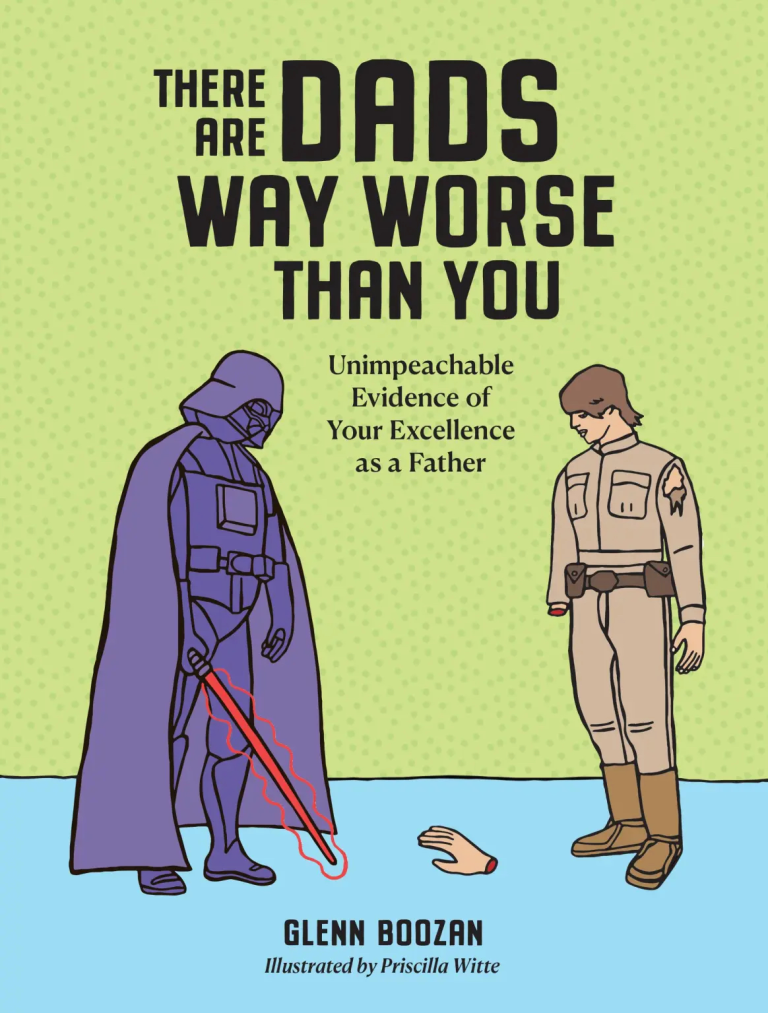
There Are Dads Way Worse than You (written by Glenn Boozan and illustrated by Priscilla Witte), by Valentina Santini
What do Akhenaten and Thanos have in common?
According to Glenn Boozan, WGA-winning and Emmy-nominated comedy writer, they are both despicable fathers.
Her book “There Are Dads Way Worse than You” – illustrated by Priscilla Witte – is addressed to those parents who believe they are not good enough. It revolves around the idea that numerous fictionalised or historical characters are or have been more disgraceful than any other father could ever be. In order to prove her point, Boozan enumerates a series of case-studies, and, for each of them, she mentions their bad parenting behaviours. The book is constructed as a children’s publication, but the audience, of course, consists of adults.
Among the numerous examples, Boozan refers to Darth Vader – and his notorious feud with his son, Luke Skywalker, whose hand the so-called Lord of the Siths intentionally cuts off with his lightsaber – or Jack Torrance, from The Shining – whose homicidal instincts against his family are well-known. In the list of these disgraceful examples of parenting, Boozan also adds an ancient Egyptian king: Akhenaten.

Photo of the author, Glenn Boozan (Source: IMDb)
She addresses the alleged issue related to this sovereign as follows:
Pharaoh Akhenaten,
That guy was real deranged.
His son – King Tut! – was so ashamed,
He had his own name changed!
The choice of including a pharaoh is notably revealing of the level of knowledge of ancient Egyptian history that the wider public is supposed to have. Akhenaten’s fame is de facto compared to that belonging to popular characters, such as Walter White, from Breaking Bad, or Dr. Frankenstein.
A question, therefore, arises: Would a king belonging to any other ancient culture have the same effect on the public? Would a reference to a Sumerian or a Etruscan sovereign obtain a similar level of understanding from the general audience?
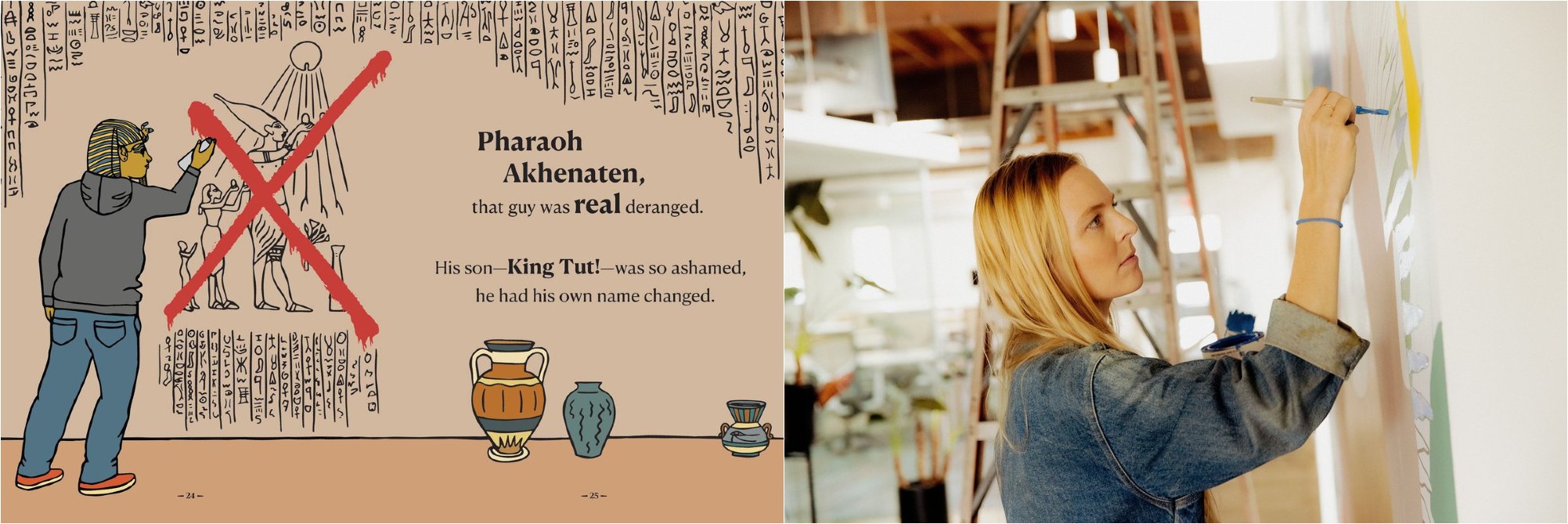
Reference to Tutankhamun and Akhenaten in Boozan’s book (left) (Source: Merritt Bookstore) and Priscilla Witte (right) (Source: P.C. Witte)
Generally speaking, the ancient Egyptian culture is perceived as one of the most popular (literally) and, for this reason, it is oftentimes employed in literature, comics, music, and other arts – even, like in this case, without using a proper and time-conscious framework. In fact, in Boozan’s work, a not-so-well-known (at least among non-Egyptologists) detail is declared: the fact that Tutankhamun changed his name after the end of the religious revolution conducted by pharaoh Akhenaten.
This crucial fact should be taken into account: a quite Egyptologically-specific element is inserted in a book intended for the wider public, and it is delivered without any clear references. Sure, that is true for all the examples in Boozan’s book. Nonetheless, the fact that one of these context-less cases belongs to ancient Egypt is definitely significant and emphasizes to what extent the knowledge (true or alleged) of ancient Egypt is permeated in our contemporary Western culture.
And little does it matter if we are not certain about Tutankhamun’s family tree and, consequently, if Akhenaten might not be Tutankhamun’s father: the reference to these two pharaohs is a compelling indicator of the fame achieved by the ancient Egyptian society in popular culture. It clearly highlights the influence that ancient Egypt still has in our everyday life.
Author: Valentina Santini (CAMNES and University of Birmingham, UK)